
5 Best Meat Thermometers for Perfectly Cooked Steaks Every Time
Top-rated instant read thermometers for perfect steak doneness. Reviews of accurate, fast, and durable models for home cooks and BBQ enthusiasts.
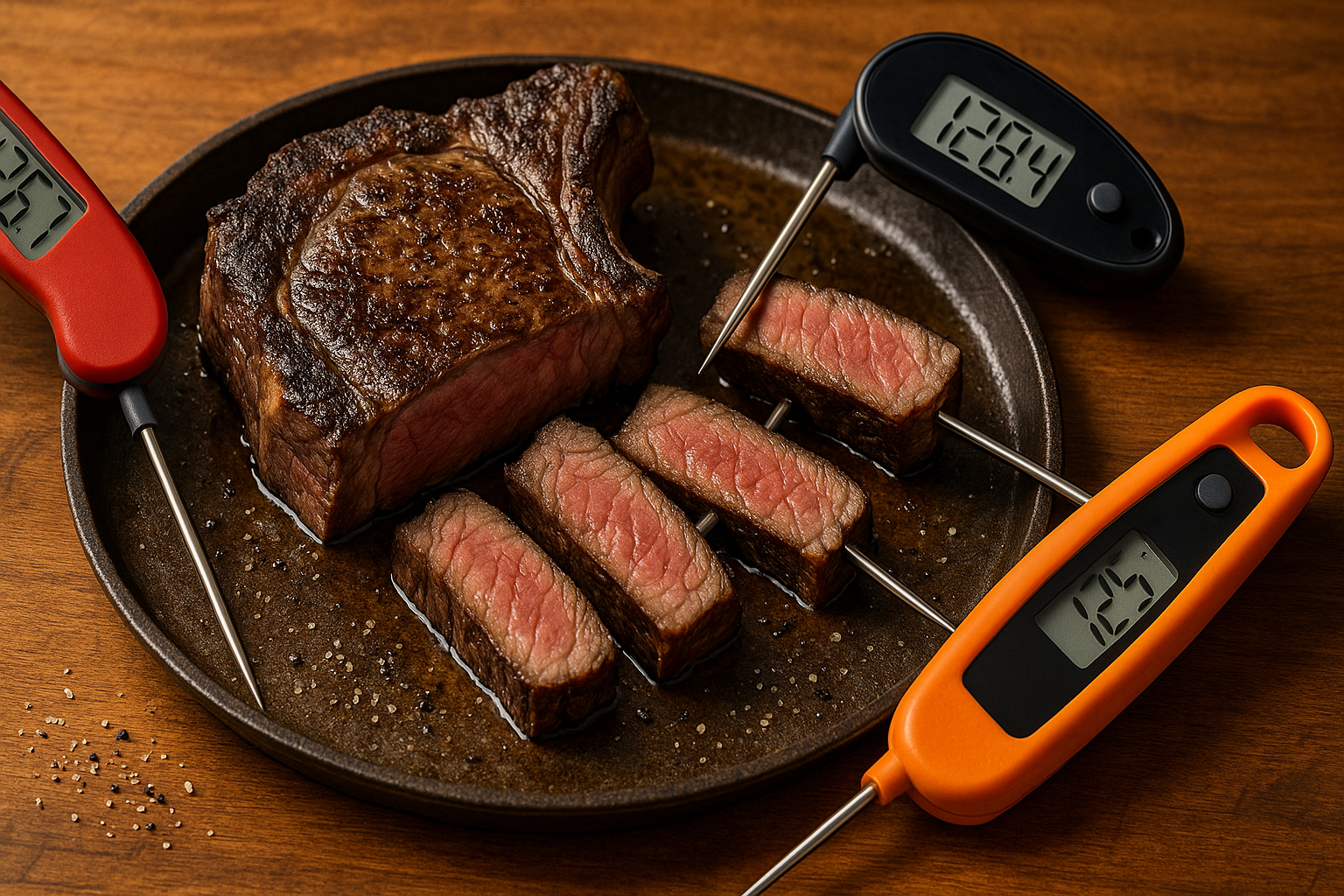
Getting the perfect steak temperature shouldn’t require guesswork. A quality meat thermometer takes the uncertainty out of cooking steaks and ensures you hit your target doneness every single time.
After testing dozens of models, we’ve narrowed it down to five thermometers that deliver consistent accuracy, lightning-fast readings, and the durability to handle regular use. These picks will transform your steak game from hit-or-miss to restaurant-quality results.
## What Makes a Great Steak Thermometer
The best meat thermometer for steaks needs to read temperatures instantly. You don’t want to leave a probe in your expensive ribeye for 30 seconds while heat escapes and your steak overcooks.
Accuracy matters just as much as speed. The difference between medium-rare (130°F) and medium (140°F) is only 10 degrees, but it completely changes the texture and flavor of your steak. A thermometer that’s off by even 5 degrees will ruin your results.
Build quality determines whether your thermometer survives years of grilling and kitchen use. Cheap models break after a few months, while well-built units last for years of regular cooking.
## 1. ThermoWorks Thermapen ONE – The Professional Choice
The Thermapen ONE reads temperatures in under one second with ±0.5°F accuracy. This level of precision and speed puts it in professional kitchens worldwide, and it’s the thermometer we reach for most often.
The 360-degree rotating display automatically orients itself for easy reading from any angle. You can take readings one-handed while flipping steaks or managing multiple pieces of meat on the grill.
At around $105, it’s expensive compared to basic models. However, the Thermapen ONE will outlast several cheaper thermometers and gives you confidence in every reading. The accuracy alone justifies the price when you’re cooking high-end steaks.
The waterproof design handles kitchen spills and outdoor grilling conditions. We’ve used ours through countless cooking sessions, and it still reads as accurately as day one.
Check current prices for the ThermoWorks Thermapen ONE on Amazon
## 2. Lavatools Javelin PRO Duo – Best Value Pick
The Javelin PRO Duo delivers 2-3 second readings with excellent accuracy at half the price of the Thermapen. For most home cooks, this represents the sweet spot of performance and value.
The large, backlit display makes it easy to read temperatures in low light conditions. Whether you’re grilling at dusk or checking steaks in a dimly lit kitchen, you’ll clearly see the temperature reading.
This thermometer includes both Celsius and Fahrenheit scales, plus a magnet on the back for easy storage on your grill or refrigerator. The build quality feels solid, and the pointed probe penetrates meat easily without creating large holes.
Battery life extends to 4,000 hours with the auto-shutoff feature. You won’t find yourself constantly replacing batteries like some cheaper models require.
At around $50, the Javelin PRO Duo gives you professional-level performance without the premium price. It’s the thermometer we recommend most often to home cooks who want reliable results.
Find the Lavatools Javelin PRO Duo on Amazon
## 3. ThermoPro TP03 – Budget Champion
The ThermoPro TP03 proves you don’t need to spend a fortune for accurate temperature readings. At under $15, it delivers 3-4 second readings that are consistent and reliable for basic steak cooking.
The large LCD display shows temperatures clearly, and the probe folds into the body for compact storage. While it lacks the premium feel of more expensive models, the TP03 performs its core function well.
This thermometer works best for occasional home cooking rather than heavy daily use. The build quality matches the price point, but it will handle regular weekend grilling sessions without issues.
For beginners or budget-conscious cooks, the TP03 removes the guesswork from steak temperatures without breaking the bank. You can always upgrade later as your cooking skills develop.
Check ThermoPro TP03 prices on Amazon
## 4. Weber iGrill Mini – Wireless Freedom
The Weber iGrill Mini connects to your smartphone via Bluetooth, letting you monitor steak temperatures from up to 150 feet away. This wireless capability shines during outdoor grilling sessions where you want to socialize rather than hover over the grill.
The companion app sends alerts when your steak reaches target temperature and includes preset temperatures for different levels of doneness. You can customize these settings based on your preferences.
The probe stays in your steak throughout cooking, which works better for thicker cuts than thin steaks. For 1.5-inch ribeyes or filet mignons, this continuous monitoring prevents overcooking better than periodic spot checks.
Battery life lasts about 200 hours of use, and the magnetic base attaches to most grills for convenient placement. The app interface is intuitive and rarely experiences connection issues.
At around $40, the iGrill Mini costs more than basic instant-read models but less than premium options. Choose this if you value the convenience of wireless monitoring over absolute speed.
## 5. OXO Good Grips ChefAlarm – Dual Probe System
The OXO ChefAlarm includes both a leave-in probe for continuous monitoring and a separate instant-read probe for spot checking multiple steaks. This flexibility makes it ideal for cooking several pieces of meat simultaneously.
You can set custom temperature alarms that beep when your steak reaches the perfect doneness. The timer function also helps track resting time, which is crucial for properly finished steaks.
The base unit sits on your counter or clips to your grill grate, keeping the display at eye level. The 36-inch probe cable gives you plenty of reach for large grills or smokers.
This thermometer excels when cooking for groups or preparing different cuts that require varying temperatures. You can monitor a thick porterhouse with the leave-in probe while spot-checking thinner cuts with the instant-read probe.
At around $60, the ChefAlarm offers unique versatility that justifies its price for frequent entertainers or serious home cooks.
## Essential Steak Temperature Guide
Understanding target temperatures is just as important as having a quality thermometer. Here are the key temperatures for perfect steaks:
**Rare:** 120-125°F – Cool red center, very soft texture
**Medium-rare:** 130-135°F – Warm red center, tender and juicy
**Medium:** 135-145°F – Warm pink center, slightly firmer
**Medium-well:** 145-155°F – Light pink center, firmer texture
**Well-done:** 155°F+ – No pink, firm throughout
Always insert your thermometer into the thickest part of the steak, avoiding fat and bone. For thin steaks under 1 inch thick, angle the probe horizontally to get an accurate reading.
Remember that steak temperature will rise 3-5 degrees during resting. Pull your steaks off the heat about 5 degrees before your target temperature to account for this carryover cooking.
## Getting the Most From Your Meat Thermometer
Calibrate your thermometer regularly using ice water (32°F) or boiling water (212°F at sea level). This ensures your readings stay accurate over time and catches any drift in calibration.
Clean the probe after each use with warm soapy water. Avoid submerging electronic components unless your thermometer is specifically rated as waterproof.
Store instant-read thermometers in a protective case or knife block to prevent damage to the probe tip. A bent or damaged probe will give inaccurate readings and can be dangerous to use.
Consider having backup thermometers available during large cooking sessions. Just like having multiple knives or spatulas, redundancy prevents disasters when equipment fails at critical moments.
Practice using your thermometer on less expensive cuts before tackling premium steaks. This builds familiarity with the tool and helps you develop consistent technique.
## Beyond Steaks: Other Uses for Your Thermometer
A quality meat thermometer serves multiple purposes beyond steak cooking. Use it to verify safe cooking temperatures for poultry (165°F), pork (145°F), and ground meats (160°F).
These same thermometers work excellently for other cooking techniques covered on our site. Whether you’re using rotisserie setups for chicken or trying smoke-free bacon cooking methods, accurate temperature monitoring improves your results.
Even Dutch oven cooking benefits from temperature monitoring, especially for braised meats that need to reach specific internal temperatures for optimal tenderness.
Oil temperature for frying, candy making, and bread baking all become more predictable with a reliable thermometer. The investment pays dividends across your entire cooking repertoire.
This helpful video demonstrates proper thermometer technique and compares several popular models:
## Common Thermometer Mistakes to Avoid
Don’t test temperature through the side of your steak. Insert the probe from the top, angling down into the center of the meat. Side insertion often hits fat layers or misses the thickest part entirely.
Avoid leaving instant-read thermometers in steaks while cooking. These aren’t designed for continuous heat exposure and will break or give false readings. Use them for quick spot checks only.
Never assume all parts of a thick steak cook at the same rate. Check multiple spots, especially on irregularly shaped cuts like T-bones or porterhouses where thickness varies significantly.
Don’t rely solely on cooking times from recipes. Steak thickness, starting temperature, and heat source all affect cooking speed. Your thermometer provides the only reliable indicator of actual doneness.
Clean your probe between different pieces of meat to prevent cross-contamination. This matters especially when checking both raw and nearly finished steaks during the same cooking session.
## Frequently Asked Questions
### How often should I calibrate my meat thermometer?
Calibrate your thermometer every 3-6 months or whenever you suspect inaccurate readings. Professional kitchens calibrate daily, but home use doesn’t require that frequency. Always calibrate after dropping or exposing your thermometer to extreme temperature changes.
### Can I use the same thermometer for all types of meat?
Yes, quality instant-read thermometers work for all meats, poultry, and fish. Just clean the probe thoroughly between different proteins to prevent cross-contamination. The same accuracy that perfects your steak cooking will improve results with steamed fish or roasted chicken.
### Why do some thermometers give different readings on the same steak?
Cheap thermometers often lack calibration and quality control, leading to inconsistent readings. Even good thermometers can show slight variations if inserted at different depths or angles. Technique matters as much as equipment quality for consistent results.
### Should I buy a wireless or instant-read thermometer?
Choose based on your cooking style. Instant-read thermometers work better for quick grilling sessions and thin steaks. Wireless models excel for thick cuts, smoking, or times when you want to monitor temperature without staying near the grill. Many serious cooks own both types.
## Making Your Choice
The ThermoWorks Thermapen ONE delivers unmatched speed and accuracy for serious cooks who demand the best. Its instant readings and bulletproof reliability justify the premium price for frequent use.
The Lavatools Javelin PRO Duo offers the best balance of performance and value. You get professional-quality results at a reasonable price, making it our top recommendation for most home cooks.
Budget-conscious cooks should choose the ThermoPro TP03. While basic, it provides accurate readings that will dramatically improve your steak results without straining your wallet.
Your choice depends on how often you cook steaks and how much precision matters to you. Any of these five thermometers will eliminate guesswork and deliver consistently perfect results. The only mistake is continuing to cook steaks without one.
This article contains affiliate links. If you purchase through these links, we may earn a small commission at no extra cost to you.


