
5 Techniques to Keep Grilled Chicken Moist and Juicy
Dry grilled chicken is the default outcome for most home cooks, but it doesn’t have to be. The problem…

Dry grilled chicken is the default outcome for most home cooks, but it doesn’t have to be. The problem isn’t grilling itself. It’s a combination of skipped prep steps, wrong heat management, and cooking by time instead of temperature. Five techniques fix the issue permanently.
Disclosure: As an Amazon Associate, this site earns from qualifying purchases. Thank you!
1. Brine or Salt Beforehand

Brining is the single biggest improvement you can make. A simple wet brine (1/4 cup kosher salt per quart of water) for 1 to 4 hours increases the chicken’s moisture content by roughly 6% to 10%. That extra moisture acts as insurance against overcooking.
The science is simple. Salt disrupts the muscle protein structure, allowing the meat to hold onto more water during cooking. When you heat untreated chicken, muscle fibers contract and squeeze out moisture. Brined chicken retains that moisture even under high heat.
For a wet brine, use cold water and fully dissolve the salt before adding the chicken. You can add sugar (2 tablespoons per quart) for browning, or aromatics like garlic, peppercorns, and bay leaves for background flavor. Submerge the chicken completely and refrigerate. Don’t brine longer than 4 hours for boneless pieces or 6 hours for bone-in cuts, or the texture turns spongy.
If wet brining is too much work, dry brine instead. Sprinkle kosher salt generously over the chicken pieces and refrigerate uncovered for 1 to 12 hours. The salt draws out surface moisture, dissolves, and gets reabsorbed along with the seasoning.
Dry brining also dries the skin, which produces better browning and crispness on the grill. Use about 1/2 teaspoon of kosher salt per pound of chicken. Don’t rinse it off. Pat the chicken dry with paper towels before grilling. For more detailed brine formulas for different meats, you can experiment with various salt ratios and timing.
Skip the brine entirely if you’re using a pre-brined or “enhanced” chicken from the supermarket. Check the label. If it lists salt, broth, or sodium solution in the ingredients, it’s already been treated. Adding more salt will make it unpalatably salty.
2. Pound to Even Thickness
Chicken breasts are thick on one end and thin on the other. The thin end overcooks and dries out before the thick end reaches a safe temperature. Pound boneless breasts between plastic wrap to a uniform 3/4-inch thickness. This takes 30 seconds and transforms your results.
Use a meat mallet or the bottom of a small skillet. Don’t smash it. Apply steady, even pressure, working from the center outward. The goal is uniformity, not thinness. A 3/4-inch thickness gives you enough mass to develop char without overcooking the interior.
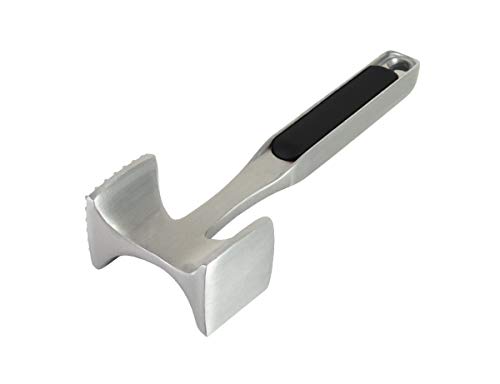
Meat Mallet
Essential for achieving even thickness in chicken breasts. Look for one with a flat side for pounding and a textured side for tenderizing.
Pounding also tenderizes by breaking down some of the muscle fibers. This matters less for chicken than for tougher cuts of beef or bison, but it still improves texture.
For bone-in pieces, even thickness isn’t possible, but you can use two-zone grilling (see below) to compensate.
3. Two-Zone Grilling

Set up your grill with direct heat on one side and no heat (or low heat) on the other. Start chicken skin-side down over direct heat for 3 to 4 minutes to develop color and grill marks. Then move to the indirect zone, close the lid, and let it finish cooking gently.
The indirect zone acts like an oven, cooking the chicken through without the risk of flare-ups and charring that come from prolonged direct heat. Bone-in pieces and whole butterflied chickens benefit enormously from this approach.
On a gas grill, turn on burners on one side only. On a charcoal grill, bank all the coals to one side or arrange them in a semicircle along the edge, leaving the center empty. Aim for medium-high heat on the hot side (around 400°F to 450°F) and 300°F to 325°F in the indirect zone.
Flare-ups are the enemy of moist chicken. Fat and marinades drip onto the coals or burners, ignite, and send flames up to char the meat. The outside burns before the inside cooks through. Two-zone grilling eliminates this problem. You get the sear without the sustained exposure to direct flame.
When you move chicken to the indirect zone, position the thickest parts toward the heat source. This compensates slightly for uneven thickness in bone-in cuts.
If you’re grilling multiple pieces, you can rotate them between zones as needed. Thin pieces stay on direct heat the whole time. Thick pieces get seared and moved. Everything finishes at the same time.
4. Use a Thermometer
This is non-negotiable. Chicken breast is done at 165°F, but if you pull it at 160°F and rest it for 5 minutes, carryover cooking brings it to 165°F with significantly more moisture retention. Dark meat (thighs, drumsticks) tastes best at 175°F to 180°F, where the connective tissue has fully rendered.
A wireless meat thermometer lets you monitor temperature without lifting the lid (which releases heat and extends cooking time).
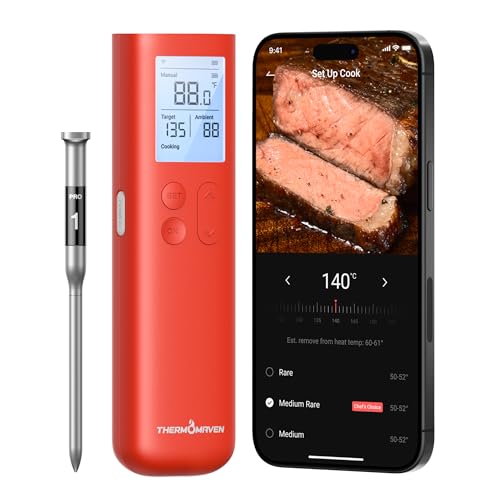
Wireless Meat Thermometer
Monitor your chicken’s temperature without opening the grill lid. Look for models with dual probes so you can track multiple pieces at once.
Insert the probe into the thickest part of the meat, avoiding bone. Bone conducts heat faster than muscle, so a bone-adjacent reading will give you a false high number. For bone-in breasts, insert the probe from the side into the center of the thick end.
Instant-read thermometers work fine for boneless cuts. Check multiple pieces if you’re grilling a batch, since thickness and placement on the grill affect cooking speed.
White meat and dark meat have different target temperatures because of their composition. Breast meat is lean, with tightly packed fibers that turn dry and stringy above 165°F. Dark meat has more connective tissue and intramuscular fat. At 165°F, thighs are technically safe but still chewy. Push them to 175°F or 180°F and the collagen breaks down into gelatin, producing tender, moist meat.
Don’t cook by time. Grill temperature, chicken starting temperature, and thickness all vary. A boneless breast might take 8 minutes or 12 minutes depending on those factors. Temperature is the only reliable indicator.
5. Rest Before Cutting
Let grilled chicken rest for 5 to 10 minutes before slicing. The muscle fibers relax and reabsorb juices that were pushed toward the surface by the heat. Cutting immediately causes those juices to spill out onto the cutting board instead of staying in the meat.
Tent the chicken loosely with foil, but don’t wrap it tightly or the skin will steam and lose its crispness. For boneless breasts, 5 minutes is enough. Bone-in pieces and whole chickens benefit from the full 10 minutes.
Resting also allows carryover cooking to finish the job. Internal temperature continues to rise by 5°F to 10°F after you pull the chicken off the grill. This is why pulling breast meat at 160°F works. By the time you slice it, it’s reached 165°F without the dryness that comes from cooking it all the way to 165°F on the grill.
Common Mistakes That Guarantee Dry Chicken

Using High Heat the Entire Time
Direct high heat is for searing, not for cooking through. If you leave chicken over a 500°F fire for 15 minutes, the outside will char and the inside will be raw or barely cooked. Use two-zone grilling or lower the heat after the initial sear.
Cooking Straight from the Fridge
Cold chicken takes longer to cook and produces uneven results. The outside overcooks before the inside warms up. Let chicken sit at room temperature for 20 to 30 minutes before grilling. This reduces cooking time and promotes even doneness.
Flipping Too Often
Constant flipping prevents browning and extends cooking time. Flip once for boneless cuts, maybe twice for bone-in pieces. Let each side develop color before you move it.
Skipping the Oil
Chicken is lean, especially breast meat. A light coating of oil before grilling adds moisture and prevents sticking. It also helps seasonings adhere. Use neutral oil like vegetable or canola. Brush it on or toss the chicken in a bowl with oil and spices.
Pressing Down with a Spatula
This squeezes out juice. Don’t do it. If the chicken is sticking, it’s not ready to flip. Wait another minute.
Timing Guide by Cut
These times are guidelines, not rules. Always verify with a thermometer.
- Boneless breast (pounded to 3/4 inch): 4 to 5 minutes per side, direct heat
- Bone-in breast: 6 to 8 minutes direct, then 15 to 20 minutes indirect
- Thighs (bone-in): 5 to 6 minutes per side direct, then 10 to 15 minutes indirect
- Boneless thighs: 5 to 7 minutes per side, direct heat
- Drumsticks: Turn every 5 minutes over medium direct heat, 20 to 25 minutes total
- Wings: Direct medium heat, turning every 3 to 4 minutes, 15 to 20 minutes total
- Whole butterflied chicken: 10 minutes skin-side down over direct heat, then 30 to 40 minutes indirect
Boneless thighs cook faster than bone-in but still benefit from slightly higher finishing temperatures. Pull them at 175°F.
Whole butterflied chickens (spatchcocked) cook more evenly than intact birds because the flattened shape exposes all the meat to consistent heat. Remove the backbone with kitchen shears, flip the bird breast-side up, and press down hard on the breastbone to flatten. Grill skin-side down first to render fat and crisp the skin, then flip and finish over indirect heat.
Marinades and Sauces
Marinades add flavor but don’t tenderize chicken significantly. Acidic marinades (vinegar, citrus, yogurt) break down surface proteins, but the effect is shallow, penetrating only a few millimeters. Oil


